

From line to surface
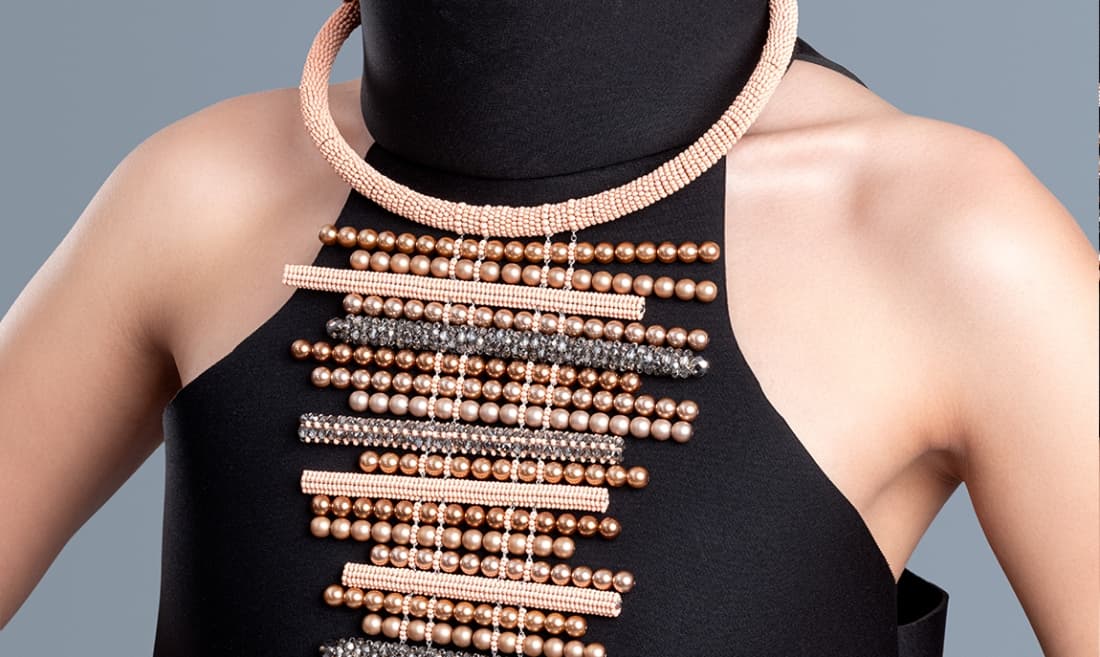
Geometry of the Future uses Rocailles and other glass beads in clean, uninterrupted paths. Rows of beads trace the body like contour lines, while deliberate areas of empty fabric become part of the composition. Luxury comes from proportion and repetition rather than maximum coverage.
Mysterious Refinement and The Power of Detail ask for a closer reading. Rocailles, tubes, and varied bead forms are positioned to control where light gathers, not simply to cover cloth. A brooch or concentrated cluster becomes a signature because of its relationship to the quieter surface around it.
Scale and a new generation
The Pavel Jevula Studio chapter changes scale through lamp beads. Larger, more individual glass forms carry a different weight and movement from a field made of thousands of small seed beads. That contrast broadens the material language beyond one size or one method of textile embellishment.
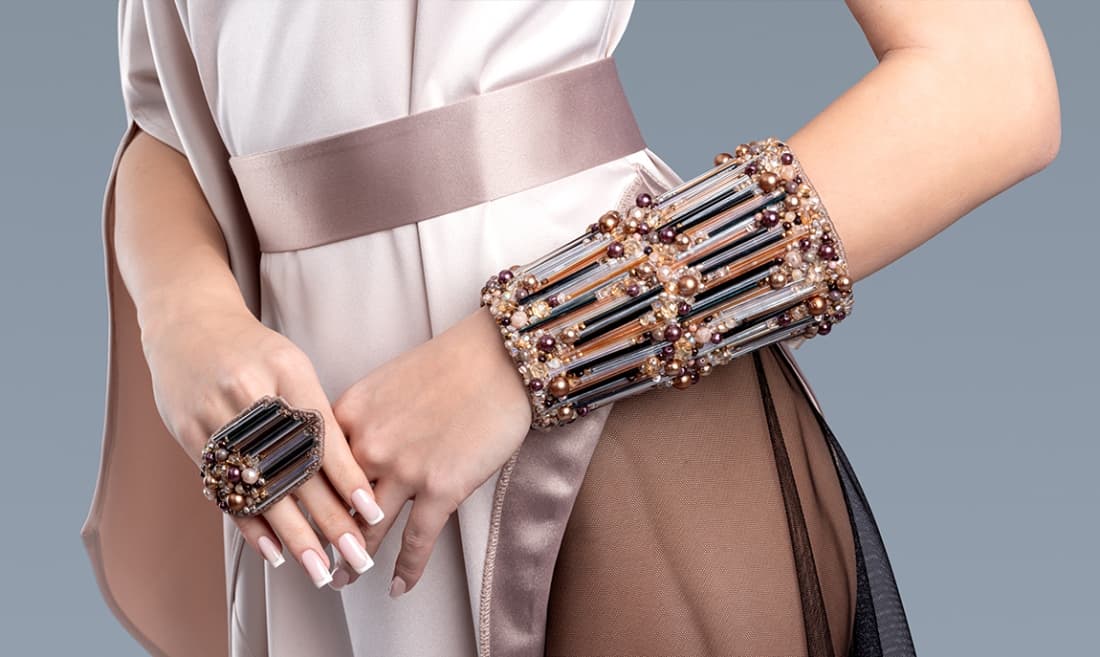

Two further chapters bring in students from art schools in Jablonec nad Nisou and Pilsen. Rocailles, tubes, and other bead forms become working material for a new generation to test proportion, connection, and application. Heritage remains active here because it is being handled and reinterpreted, not simply displayed.
Turning the runway into method
What connects the seven directions is less a shared palette than a shared production network. Glassmaker, jewelry designer, fashion atelier, and school each assign a different function to the same material. From a distance the result reads as one surface; up close it becomes a record of stitching, weight, attachment, and movement decisions.
For a new project, read this runway as a technical comparison rather than a look book. Decide whether the bead should draw a line, build a surface, create movement, or hold a focal point; then test size, spacing, and finish on a small sample. The official story and gallery make it possible to compare all seven approaches in detail.